From Trash to Treasure: How Ocean Pollution Serves As an Educational Tool & Art
Lauren Multari
Each year, tens of millions of pieces of trash make their way into the ocean. Only a small portion of pollution is recovered and removed. The Ocean Conservancy oversees the International Coastal Cleanup project, a coalition of thousands of volunteers across the globe dedicated to restoring our ocean. With locations across the globe, volunteers and partner organizations organize to remove trash from local waterways. Across 15,000 miles of coastline, over 7,000,000 pounds of trash were collected (Ocean Conservancy, 2025). In addition to the 15 million pieces of trash collected, even more is cleaned by average beachgoers and thoughtful citizens. Solving the ocean pollution crisis requires more than simply picking up trash; it includes fundamental shifts in human behavior. So how can we be sure this trash doesn’t eventually make its way into the ocean again?
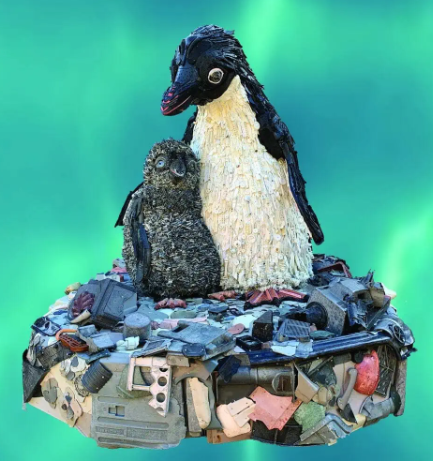
‘Washed Ashore’ is a curriculum created by the National Oceanic and Atmospheric Administration (NOAA). In partnership with NOAA’s Marine Debris Program, Washed Ashore presents plastic animals that travel the world with the organization to educate children on ocean pollution and the power of art (Washed Ashore - Curriculum). The curriculum is divided into 12 unique lessons, with material lists, introductory material, and extension lessons offered. Washed Ashore begins by explaining how plastics are made, their chemical composition, and how they make their way into our oceans (Washed Ashore - Curriculum Summary). Large pieces of plastic, bottle caps, and whole-sized pieces of plastics are often the first type of marine debris that individuals think of. However, plastics can also make their way into the ocean through corrosion and similar chemical processes that slowly degrade materials such as metals (Tontoton). Infrastructure close to waterways may aid in the purposeful or accidental pollution of debris and plastics that eventually harm our environments and beloved species (Tontoton).
Similarly, plastics differ in their lifespan and general ecosystem impacts. Plastic bags have been a focal point of sustainable planning and encouragement in the past few decades. However, they have one of the shortest life spans of all plastics. Persisting in the environment for only 20 years, plastic bags account for only 4% of the lifespan of plastic toothbrushes (WWF, 2025). Coffee pods, plastic diapers, and some plastic cups remain in the environment for around 500 years (WWF, 2025). Washed Ashore considers the variety of manufactured plastics and tailors lessons to highlight single-use plastics, the evolution of manufacturing, and the various uses of plastics (Washed Ashore - Curriculum Summary). With these lessons, students become well-educated on various aspects of marine debris, rather than focusing on only one type of plastic.
While fixation on one type of pollution can certainly be beneficial, as seen by recent plastic bag and utensil bans, the marine debris crisis demands a more holistic approach. Despite infrastructure and dedicated efforts, not all plastics are properly recycled. In Australia, only 19% of plastics were recycled in 2024, with a striking 75% of plastic bottles not making their way into the recycling stream (WWF, 2025). Additionally, recent EPA research has identified that only 32% of American trash is actually recycled, even with 77% of American citizens claiming they recycle (Quinn, 2025). System creation to properly address all plastics, from plastic bags to plastic diapers, requires a vast amount of money, space, and time. Unfortunately, these resources are not always readily available. Learning to change our habits and utilize current plastic waste in a more effective way is of the utmost importance.
Washed Ashore dedicates three whole lessons to the history of art and its usefulness in the marine debris crisis. Lesson 2 provides an introduction to using plastics and materials in art to display emotion and meaning, with a specific focus on texture in Lesson 4 (Washed Ashore - Curriculum Summary). In addition, each lesson features a hands-on activity to keep students engaged and reinforce the discussed topics. Lesson 8, dedicated to the analysis of single-use plastics, features an engaging hands-on activity to create T-shirt bags (Washed Ashore - Curriculum Summary). Throughout the curriculum, Washed Ashore guides students through artistic creations prompted by educational discussion. As students make T-shirt bags in Lesson 8, they also explore the environmental impacts impacted with bags of different materials. Although well-intentioned, students are able to avoid returning discovered marine debris to recycling programs that can not guarantee execution. After the completion of the curriculum, students are equipped with methods to handle the marine debris crisis, fueled by scientific knowledge.
NOAA’s program is not the only commitment to the intersection of the arts and sciences. Art competitions, beach cleanup outings, and environmental presentations serve as stepping stones to educating communities on the true extent of ocean pollution. By direct engagement with communities, it is possible to minimize environmental catastrophes and uplift ecosystems. Despite how separate certain industries may seem, all sectors are connected by the shared interest in the continuation of a thriving environment. Washed Ashore serves as a powerful example of the accomplishments that occur when industries unite to educate communities and encourage environmental practices.
Citations
Quinn, Megan. (2025). By the numbers: How America recycles in 2025. Wastedive. https://www.wastedive.com/news/how-america-recycles-in-2025-film-curbside-battery-extended-producer-responsibility/805296/
(2025). The Lifecycle of Plastics. World Wildlife Fund. https://wwf.org.au/blogs/the-lifecycle-of-plastics/
Curriculum - Ocean Conservation Lesson Plans. Washed Ashore. https://www.washedashore.org/curriculum/
The Environmental Impact of Different Types of Plastic and How Recycling Helps. Tontoton. https://tontoton.com/the-environmental-impact-of-different-types-of-plastic-and-how-recycling-helps/
Integrated Arts Marine Debris Curriculum Summary. Washed Ashore. https://marine-debris-site-s3fs.s3.us-west-1.amazonaws.com/s3fs-public/publications-files/Washed_Ashore_IAMDC_Curriculum_Overview.pdf?VersionId=mN60EmLW8RzUdlxXbQ7aQDCml6NyfR3a
International Coastal Cleanup ‘24-25 Report. Ocean Conservancy. https://oceanconservancy.org/wp-content/uploads/2025/09/FINAL_ICCAnnualReport_Digital.pdf