The Hidden Plastic Problem in Kelp Forests
Julia Fox

Off the coast of Baja California, Mexico, giant kelp rises from the seafloor like a submerged forest, its fronds stretching toward the sunlit surface. Although kelp resembles a plant, it is actually the world's largest brown alga, anchored to rocky reefs by root-like holdfasts and buoyed by gas-filled bladders (Mexican Marine Life). Growing as much as two feet per day under ideal conditions, giant kelp forms underwater forests that provide food, shelter, and nursery habitat for hundreds of marine species while buffering coastlines from waves and helping capture carbon (Monterey Bay Aquarium).
Like a forest on land, a kelp forest has a floor, a midstory, and a canopy, with different animals occupying each layer. Near the base, sea stars, anemones, and urchins live among the holdfasts that anchor kelp to the rocky bottom, along with the fish, like sheephead, that hunt them from there. Partway up, snails, kelp crabs, and rockfish move along the stipes. At the surface, sea otters, sea lions, and seals swim through the canopy itself (Office of National Marine Sanctuaries). This structure matters because pollutants often enter at different depths: dissolved contaminants near the surface and sediment-bound ones near the bottom (National Science Foundation). Kelp itself carries material between those layers, as grazed or decaying blades sink from the canopy toward the seafloor. Animals that forage across layers, such as sea otters diving for shellfish before resting at the surface, end up absorbing contamination from both ends of the water column simultaneously (Jessup et al. 1648).
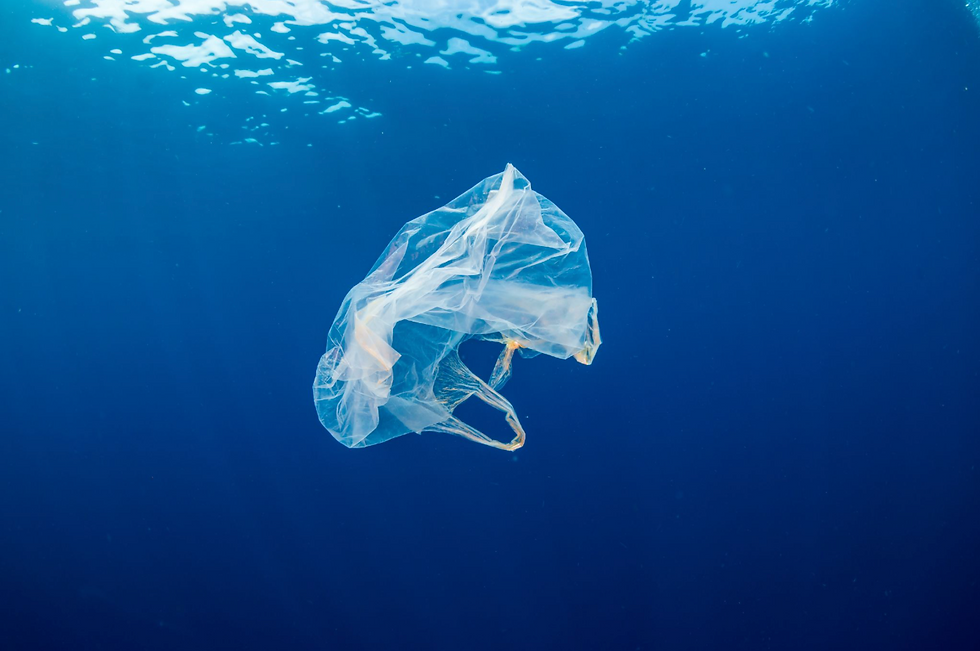
One of the pollutants moving through this underwater forest is plastic, though not in the form most people picture. Microplastics are plastic particles smaller than five millimeters and are now among the most widespread pollutants in coastal ecosystems (Lozano-Hernandez et al.). They originate from sources such as synthetic clothing fibers, degraded plastic litter, and industrial materials. Once in seawater, these particles drift with currents, settle onto the seafloor, or attach to living surfaces before being consumed by organisms that filter, graze, or hunt. Because they can also adsorb chemicals such as flame retardants and other contaminants, microplastics may expose marine organisms to both plastic particles and the pollutants they carry.
To understand how microplastics move through a kelp forest ecosystem, researchers focused on a simple food chain consisting of giant kelp, the purple sea urchins that graze on it, and the California sheephead that prey on those urchins. In a 2024 study published in Environmental Research, Lozano-Hernández et al. examined three kelp forests in Todos Santos Bay, Baja California. Using microscopy along with Raman spectroscopy, a non-destructive analytical technique that identifies materials and analyzes their molecular structure (Raja and Barron), researchers detected microplastics in every component of the system, including kelp tissue, sea urchins, California sheephead, and surrounding seawater. The study also identified polybrominated diphenyl ethers (PBDEs), a class of flame-retardant chemicals once widely used in plastics, electronics, furniture, and textiles. The presence of these pollutants across multiple levels of the kelp forest ecosystem demonstrates how human-produced contaminants can persist in marine environments and potentially move through food webs (Lozano-Hernández et al.). Although many PBDE formulations have since been phased out due to concerns about their persistence and toxicity, these chemicals remain widespread contaminants in marine ecosystems. Because microplastics can attract and transport chemical pollutants such as PBDEs, these findings suggest that marine organisms may be exposed not only to plastic particles themselves but also to the harmful substances that attach to them as they move through the food web.
For scientists, tracing microplastics through giant kelp, sea urchins, and California sheephead offers more than a snapshot of pollution. It reveals how contaminants move through an entire food web, highlighting that even ecosystems that appear healthy can quietly accumulate human-made debris. Addressing this issue requires both reducing plastic pollution at its source and improving strategies to prevent existing waste from entering marine environments. Individuals can help by reducing single-use plastics, choosing reusable alternatives, properly disposing of waste, and participating in local coastal cleanups (Lozano-Hernández et al.). However, meaningful change also depends on larger policy and industry efforts, including improving waste management systems, limiting unnecessary plastic production, and developing more sustainable materials. Continued scientific monitoring of ecosystems such as kelp forests is also essential for understanding how pollution changes over time and for guiding conservation efforts to protect marine biodiversity.
Citations
Jessup, David A., Melissa A. Miller, Christine Kreuder-Johnson, Patricia A. Conrad, M. Tim Tinker, James A. Estes, and Jonna A. K. Mazet. "Sea Otters in a Dirty Ocean." Journal of the American Veterinary Medical Association, vol. 231, no. 11, 2007, pp. 1648-1652, https://avmajournals.avma.org/view/journals/javma/231/11/javma.231.11.1648.xml.
Lozano-Hernández, Eduardo Antonio, Nancy Ramírez-Álvarez, and Lucy Coral Alarcón-Ortega. “The Hidden Microplastics in Kelp Forests.” Frontiers for Young Minds, 2026, https://kids.frontiersin.org/articles/10.3389/frym.2026.1604450.
Lozano-Hernández, Eduardo Antonio, Nancy Ramírez-Álvarez, Lorena Margarita Rios Mendoza, José Vinicio Macías-Zamora, Adán Mejía-Trejo, Rodrigo Beas-Luna, and Félix Augusto Hernández-Guzmán. “Kelp Forest Food Webs as Hot Spots for the Accumulation of Microplastic and Polybrominated Diphenyl Ether Pollutants.” Environmental Research, vol. 257, 2024, article 119299, https://pubmed.ncbi.nlm.nih.gov/38824984/.
Mexican Marine Life. “Giant Kelp (Macrocystis pyrifera).” Mexican Marine Life, 2021, https://mexican-marine-life.org/giant-kelp/.
Monterey Bay Aquarium. “Kelp Forest.” Monterey Bay Aquarium, https://www.montereybayaquarium.org/animals-the-ocean/ecosystems/kelp-forest.
National Science Foundation. "Researchers Discover Microplastics at All Ocean Depths." NSF - U.S. National Science Foundation, 16 June 2025, https://www.nsf.gov/news/researchers-discover-microplastics-all-ocean-depths.
Office of National Marine Sanctuaries. “Kelp Forests.” National Marine Sanctuaries, National Oceanic and Atmospheric Administration, https://sanctuaries.noaa.gov/visit/ecosystems/kelpdesc.html.
Raja, Pavan M. V., and Andrew R. Barron. "4.3: Raman Spectroscopy." Chemistry LibreTexts, last updated 6 Jan. 2025, https://chem.libretexts.org/Bookshelves/Analytical_Chemistry/Physical_Methods_in_Chemistry_and_Nano_Science_(Barron)/04%3A_Chemical_Speciation/4.03%3A_Raman_Spectroscopy.